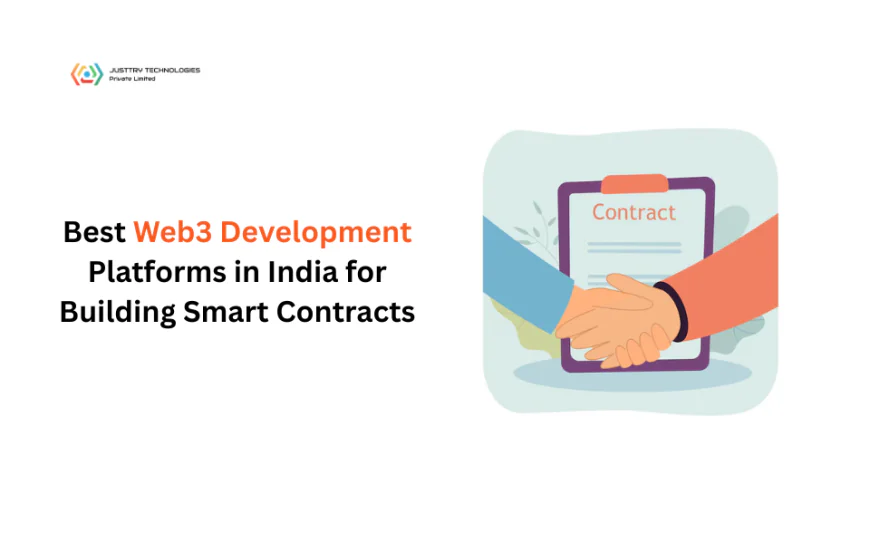
Best Web3 Development Platforms in India for Building Smart Contracts
Top Web3 development platforms in India for building smart contracts, tools, and frameworks that empower decentralized apps with speed and security.
 vanaraj
India is no longer simply a recipient of international conversations about the blockchain ecosystem. The country has emerged as a very important player, due to a plethora of factors, including a high density of blockchain developers, rapidly emerging startups, and institutional engagement from every sector. Bangalore, Hyderabad, Pune, and Mumbai boast vibrant blockchain developer communities who are actively building decentralized applications, tokenization products, and protocols.
With so much activity happening in space, it is no surprise that India has reached an interesting crossroads. Businesses crave reliability. Startups crave growth. Developers crave cutting-edge tooling. And so the question today isn’t what to build on Web3; rather, it’s who to build with on Web3.
What Are Smart Contracts and Why Do They Matter?
Smart contracts are programs that execute autonomously on blockchain networks. They follow predetermined terms and conditions through automated procedures without any need for intermediaries or arbitrators. Essentially, smart contracts in blockchain technology operate just like digital vending machines. When you enter the right input, you get the desired output immediately.
Smart contracts enable:
-
Automation in finance by eliminating intermediaries in lending and settlements
-
Transparency in supply chains through tamper-proof tracking
-
Decentralized voting and governance systems
-
Digital ownership via NFTs, royalties, and tokenized assets
Indian businesses are actively applying these use cases across fintech, logistics, healthcare, and real estate.
Key Criteria for Choosing a Web3 Development Platform
The technical and business factors that need to be considered before selecting a blockchain platform are numerous.
Not all blockchains are appropriate for all use cases. The transaction speed, throughput, and latency dictate how fast transactions can be validated.
The gas fee is the cost of executing transactions on the blockchain. If one blockchain is too expensive, then it may make the consumer-facing application unsustainable financially.
The developer ecosystem maturity is another factor to consider. SDKs and good documentation will save time spent building the blockchain application.
The security aspect is also crucial. It would help if you chose a blockchain with a proven history of secure consensus mechanisms and resilience against exploitation tactics.
Interoperability is the capability of communication between different blockchains.
Top Web3 Development Platforms Used in India
Ethereum
Ethereum emerges as the ideal choice when it comes to building smart contracts. The reason is that its EVM has become the de facto standard and can even facilitate coding in languages like Solidity and Vyper. The Indian community of developers creating DeFi, DAO, and tokenization solutions leverages the Ethereum ecosystem, which consists of OpenZeppelin, Hardhat, and Alchemy, among others. However, expensive transactions are a common occurrence during network congestion.
Binance Smart Chain (BNB Chain)
The advantage of BNB Chain lies in its EVM compatibility and low transaction fees. Teams that are familiar with Solidity programming languages can easily port their code to the BNB chain or develop new projects alongside it without any hassles. However, the disadvantage here is that it follows the Proof of Staked Authority protocol, which leads to the centralization of validators.
Solana
The distinguishing feature of Solana in relation to others is that it utilizes a unique design model, which involves the combination of Proof of History and Proof of Stake mechanisms, thereby offering greater transaction speeds than most other blockchain technologies. Solana is ideal for applications that require high performance, including gaming, decentralized exchanges, and real-time feeds. Indian programmers can develop applications on Solana using programming languages like Rust and C, which are harder to learn than Solidity.
Tools and Frameworks That Indian Developers Rely On
Choosing a blockchain is just the beginning; the execution relies on the tools used. Hardhat has emerged as the leading platform for EVM-based development owing to its excellent debugging and testing capabilities. Foundry has seen rapid adoption in recent times among security-conscious organizations owing to its high-speed operations and support for fuzz testing.
OpenZeppelin offers audited and production-tested libraries for smart contracts, and Chainlink enables safe integration with external sources of information like price feeds and randomness. Proficiency in this ecosystem is crucial for any organization providing web3 smart contract development services.
Why Choose Justtry Technologies?
Justtry Technologies, a trusted smart contract development company, provides complete smart contract development services on platforms like Ethereum, Polygon, and BNB Chain. Their team helps with token design, building secure protocols, auditing contracts, and supporting projects even after launch. Throughout the process, they keep everything clear, simple, and transparent for clients.
Conclusion
The world of Web3 in India is not speculative; it is being built. Platform maturity has improved, tools are becoming more stable, and there are better opportunities now for real blockchain-based product development than ever before. Choosing the right platform is important, but choosing the right team is even more critical. Even a bad contract on the right network could bring down your entire project. If you are a founder, an enterprise, or a developer, success requires both.